
Injection Mold Development – Tool Engineering for an Overmolded 48V Leadframe Holder
Development of a dedicated automation cell for part removal, orientation, inline inspection and OK/NOK separation in a high-volume injection molding environment. The engineering scope focused on robust machine integration, repeatable part handling and stable inspection logic for continuous serial production.
Project Overview
Developing a Tool Concept for a Position-Critical Hybrid Component
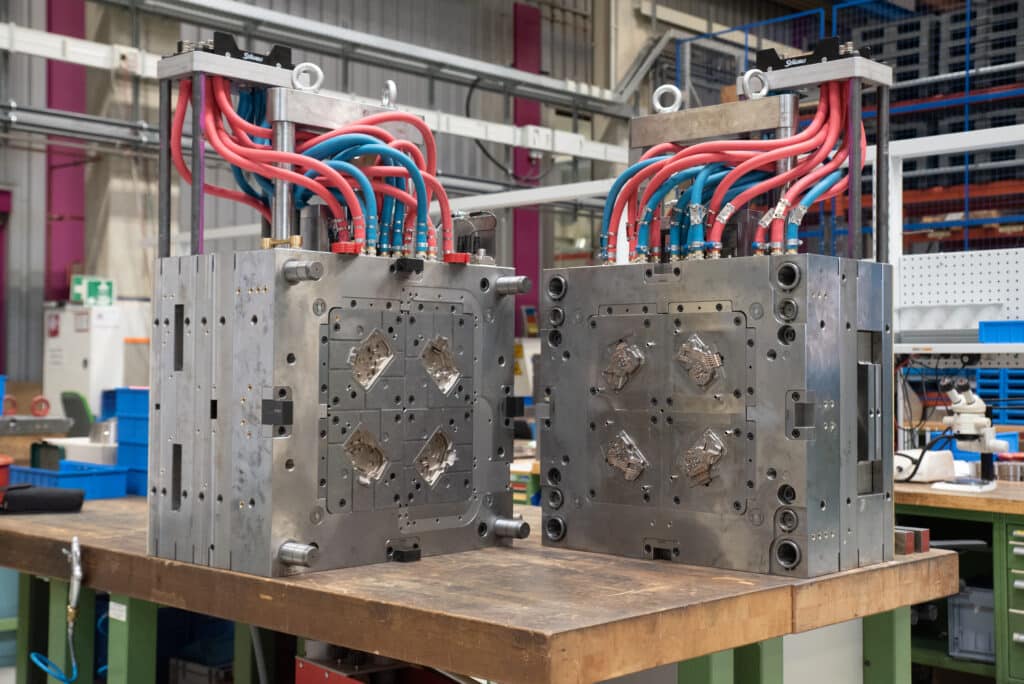
This project focuses on the development of an injection mold for a hybrid plastic-metal component in which a leadframe had to be overmolded with high positional accuracy and process stability. The engineering task was not the full manufacturing program, but the tool-development work required to transform a sensitive insert-based component into a robust serial molding concept. That is directly aligned with MATEtronix’s documented competencies in Injection Molding Tool Design, Mold Flow Analysis, DFM and Complex Hybrid Plastic-Metal Molding.
The current MATEtronix site also states that the company covers the value chain from concept and component analysis to tool construction and series production, and specifically highlights in-house tool design and toolmaking
Requirements and Challenges
Insert Positioning, Flow Control and Tool Robustness in One Mold Concept
The main engineering challenge in this type of project is that the mold has to do more than shape a plastic part. It must also define how the metallic insert is positioned, fixed, encapsulated and released without creating deformation, flash or short shots. This challenge profile is consistent with MATEtronix’s positioning around hybrid injection molding and plastic-metal combinations.
Likely key requirements:
- precise positioning of the leadframe insert during molding. (Inhalt nicht validiert, bitte prüfen.)
- stable encapsulation of critical conductor or contact areas. (Inhalt nicht validiert, bitte prüfen.)
- controlled filling around insert geometry to avoid air traps or weld-line issues. (Inhalt nicht validiert, bitte prüfen.)
- optimized cooling to maintain repeatable cycle behavior and dimensional stability. (Inhalt nicht validiert, bitte prüfen.)
- tool layout compatible with automated insert loading or downstream automation. (Inhalt nicht validiert, bitte prüfen.)
Typical engineering challenges:
- movement or distortion of the insert during injection. (Inhalt nicht validiert, bitte prüfen.)
- uneven flow fronts around thin metallic features. (Inhalt nicht validiert, bitte prüfen.)
- local stress or shrink effects at transition zones between metal and plastic. (Inhalt nicht validiert, bitte prüfen.)
- complex venting and sealing requirements in the cavity area. (Inhalt nicht validiert, bitte prüfen.)
Solution & Technologies
A Tooling Concept Built Around Insert Stability and Manufacturability
The strongest engineering narrative for this project is a tool-development workflow built around DFM, simulation and tool-concept refinement before serial validation. That sequence is directly supported by the company material, which lists Injection Molding Tool Design, Design for Manufacturability, Mold Flow Analysis and Simulation and Injection Molding Process Development as core capabilities.
Likely project approach:
- DFM review of the hybrid part geometry and insert interface.
- definition of insert location, cavity concept and clamping/support logic. (Inhalt nicht validiert, bitte prüfen.)
- mold flow analysis to optimize gate location, fill behavior and pressure balance around the leadframe.
- cooling and venting concept development to reduce local instability and cycle risk. (Inhalt nicht validiert, bitte prüfen.)
- design of wear-critical tool areas and maintenance-relevant components for serial durability. (Inhalt nicht validiert, bitte prüfen.)
- preparation of T1-Tn validation logic for dimensional, visual and functional assessment. This is consistent with the tooling case-study structure already present in your content draft.
Technologies involved:
- Injection Molding Tool Design
- Design for Manufacturability (DFM)
- Mold Flow Analysis and Simulation
- Hybrid / plastic-metal overmolding
- Injection Molding Process Development
- Tool validation from pilot to serial stage. (Inhalt nicht validiert, bitte prüfen.)
Results / Project outcome
A Tool Platform Prepared for Stable Hybrid Serial Production
For this Engineering case, the result should be framed as a robust mold concept that enables repeatable insert overmolding and supports a stable downstream manufacturing process. The most credible outcome is not a generic productivity claim, but a validated tool architecture that reduces technical risk before serial ramp-up. That matches both the tooling content direction in your draft and the MATEtronix capability stack.
Likely outcomes:
- improved insert positioning consistency. (Inhalt nicht validiert, bitte prüfen.)
- lower risk of flash, short shots or encapsulation defects. (Inhalt nicht validiert, bitte prüfen.)
- more stable filling behavior through optimized gating and venting. (Inhalt nicht validiert, bitte prüfen.)
- better maintainability and serial readiness of the mold design. (Inhalt nicht validiert, bitte prüfen.)
- smoother transition into process validation and production ramp-up. (Inhalt nicht validiert, bitte prüfen.)




 MATE inc.
  MATEtronix GmbH & Co. KG
 MATEtronix s.r.o
  MATEtronix Technology